
In Response to the Trump Administration’s Weakening of the Endangered Species Act
By: Isabelle Munsell
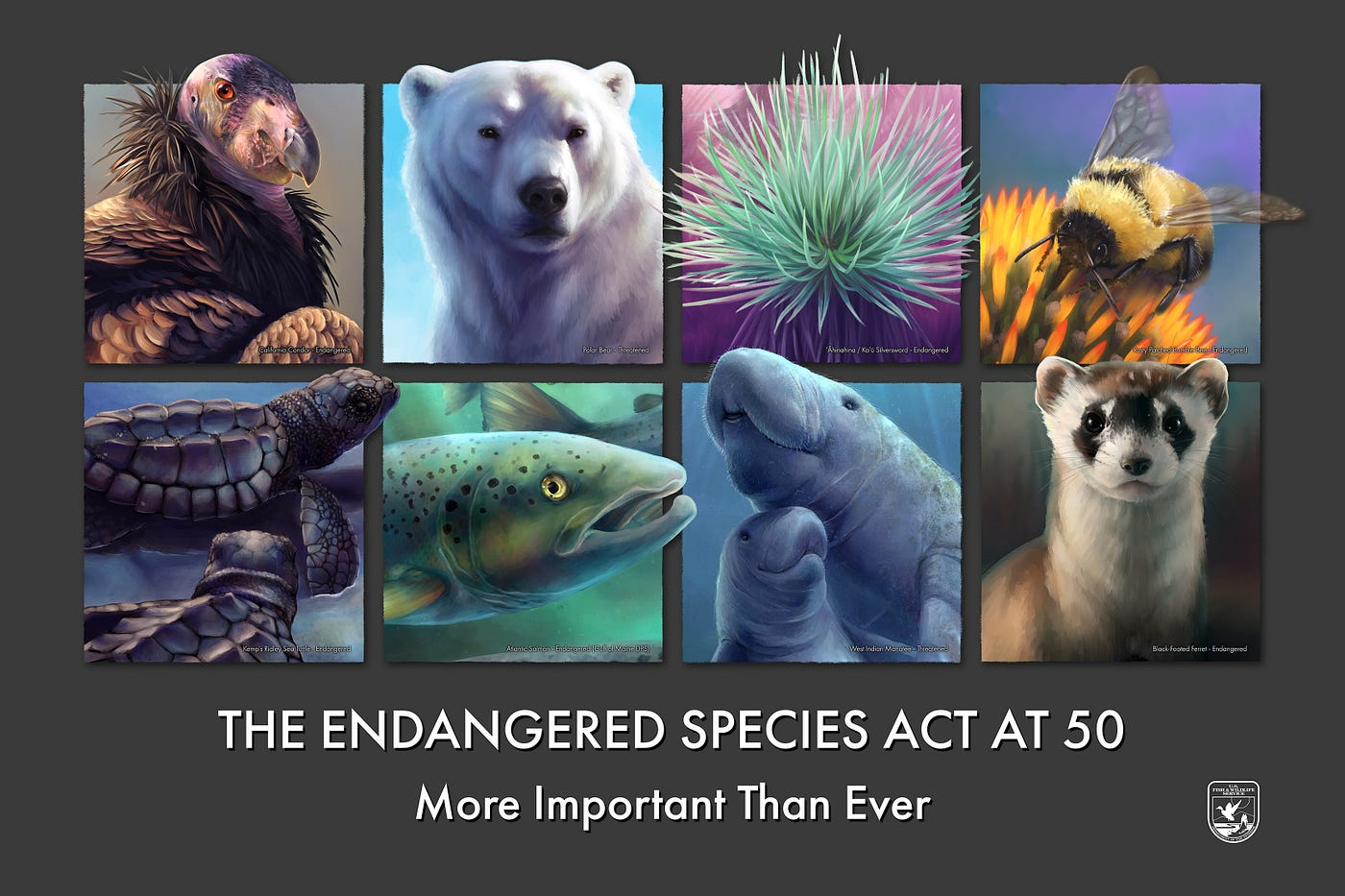
The Endangered Species Act is a critical environmental law, just over fifty years old, that provides a fundamental pathway to prevent the extinction of plants, fish, and wildlife. Enacted in 1973 with overwhelming bipartisan support, it stands as one of the nation’s most comprehensive and powerful conservation statutes. The Act’s strength has historically derived from its commitment to making decisions based solely on the best available scientific and commercial data, without consideration of economic impacts, a principle that has been a cornerstone of its effectiveness. The Endangered Species Act has been through periods of strengthening and weakening, corresponding to changes in administrations. During President Biden’s Administration, the Act was amended to favor the very species the Act was intended to protect. These amendments involved reinstating broader protections for threatened species and reaffirming the role of climate science in conservation planning, reflecting a regulatory philosophy that prioritizes precaution in the face of ecological uncertainty.
However, as of November 2025, the Trump Administration, through the Department of the Interior’s U.S. Fish and Wildlife Service, proposed four rules to reinstate the 2019 and 2020 framework. The previous framework heavily benefits the energy sector, aligning with President Trump’s intent to strengthen American energy independence with the executive order declaring a state of “energy emergency.” This regulatory shift underscores a fundamental philosophical divergence, where environmental regulations are viewed primarily through the lens of their perceived burden on industrial and economic development rather than as a necessary safeguard for the nation’s natural heritage.
The latest proposal plans to eliminate the “blanket rule” known as 50 CFR part 17, section 4(d), which extends endangered-level protections to newly proposed threatened species. Instead, the proposed rule requires species-specific rules tailored for each species, which could cause a loss in any species-specific gain as a result of their protected status under the Endangered Species Act. This “blanket rule” has been a critical tool for the Fish and Wildlife Service, who are often hampered by limited resources and a lengthy backlog of species awaiting protection. This new requirement is a lengthy process and creates a large gap in protection for a threatened species, contradicting the very purpose of the act. During the years-long period it takes to draft, propose, and finalize a species-specific rule, the species remains in a legal limbo, vulnerable to threats that would have otherwise been prohibited.
Additionally, the second change revolves around the listing of a new endangered species, relying less on scientific data and more on economic impact. Before, to list a new species as endangered, the Fish and Wildlife Service would use the severity of extinction based on science to make this determination. However, this new proposal suggests that the economic impacts of listing a species as endangered are now an acceptable consideration. This would mean that the federal government could justify not protecting a threatened species over the loss of revenue a potential commercial land developer would experience from prohibiting building on the threatened species’ habitat. In practice, this could lead to scenarios where a species known to be on the brink of extinction is denied protection because the cost to a specific industry is deemed too high, effectively placing a price tag on survival.
The proposed rule also puts forward a narrowed definition of “critical habitat.” Previously, a “critical habitat” included currently unoccupied but historic habitat. This proposal excludes these habitats. Historic habitats are quintessential for the recovery of threatened species, especially in the face of climate change and loss of biodiversity. If finalized, this would lead to a significant decrease in protected critical habitat for endangered species, exacerbating habitat loss for threatened species.
Lastly, the proposal relaxes compliance measures by eliminating the definition of “harm.” Under the Endangered Species Act, “harm” is defined as “significant habitat modification or degradation" that “actually kills or injures wildlife.” Wholly rescinding the rule creates loopholes for agencies to sidestep species protections and greenlight destructive practices such as logging and drilling. Without a clear definition, it becomes exceedingly difficult to hold parties accountable for actions that indirectly lead to the injury or death of protected wildlife, rendering a key enforcement mechanism of the Act virtually toothless.
As a proposed rule, the agency is receiving public comments until mid-December. In response, various organizations like EarthJustice and the Center for Biological Diversity have made declarations on their websites of opposition to the proposed rule. Additionally, per the Administrative Procedure Act, organizations have encouraged the public to submit public comments and are prepared to impose legal action in the event the proposed rule is finalized. Others are taking a state-level legislative approach, such as Oregon. Oregon has proposed a “1% for Wildlife” proposal, which would contribute a meaningful increase in lodging tax to support wildlife conservation, community resilience projects, and habitat restoration. This state-level action highlights a growing trend where local governments, anticipating a retreat from federal conservation leadership, are seeking to create their own funding mechanisms and regulatory safeguards to protect their natural resources for future generations.